
Classroom management refers to the “…actions teachers
take to create an environment that supports and facilitates both academic and
social-emotional learning.” (Evertson & Weinstein, 2006, as cited by
Eggen & Kauchak, 2009, p. 354) |  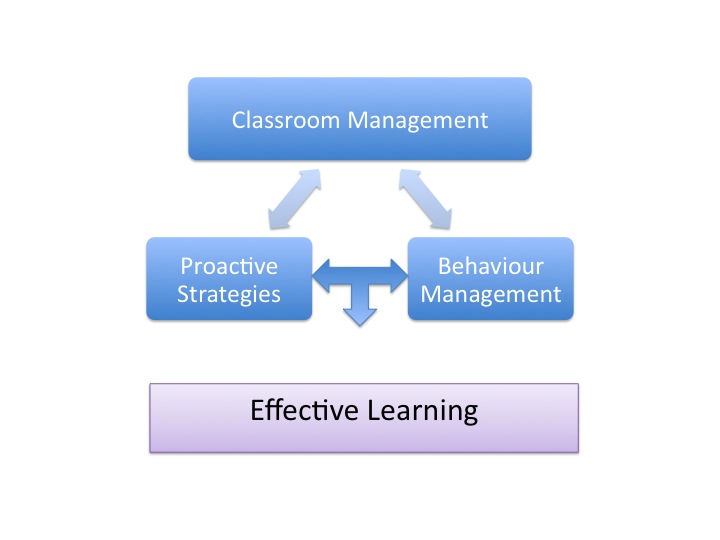 |
Proactive Strategies Vs Behaviour Management
Firstly one needs to consider classroom management in terms of developing proactive classroom management strategies that are distinctly different from reactive responses to undesired behaviour. It is essential to develop a productive learning environment in which “…students feel physically and emotionally safe, and the daily routines, learning activities, and standards for appropriate behaviour are all designed to promote learning” (Eggen & Kauchak, 2009, p. 352)
Proactively preventing student misbehaviour is the key to successful classroom management, however whilst teachers strive for such ideals there will inevitably be some students who "...seem either unable or unwilling to accept responsibility for their behaviour." (Eggen & Kauchak, 2009, p. 376) In these cases behavioural interventions, in the form of reinforcements and punishments will be necessary. Careful use of behaviourist aspects of learning such as 'classical conditioning' and 'operant conditioning', based on research from Pavlov, Watson and Skinner (Fetherston, 2006), may be helpful in managing classrooms in 2010 and beyond, bearing in mind that ulimately "Behaviour management is about teaching children to be responsible for their own behaviour." (Department of Education and Training of Western Australia [DETWA], 2005c, p. 101)
 | Considered a less effective learning theory than constructivism and other cognitive learning theories, behaviourism may still be beneficial in helping teachers deal with student misbehaviour. Using behaviourist strategies to reinforce positive behaviour is considered an effective tool in managing future classrooms. (Eggen & Kauchak, 2009) |
Behaviour Management
" Misbehaviour can never be eliminated, but the trauma and unpleasantness associated with misbehaviour can be channelled appropriately if the teacher plans carefully and demonstrates a role model that is fair and consistent." (Marsh, 2008, p. 191)
Considered the cornerstone of effective behaviour management systems are a set of constantly monitored class rules. To affect student ownership of class rules it is important to involve them in the initial development and ongoing reflective process needed to evaluate rule effectiveness. Paramount to the effectiveness of class rules is the need to establish them early in the first days of the school year. “Research consistently confirms that patterns of behaviour for the entire year are established in the first few days of school” (Eggen &Kauchak, 2009, p. 358)
However it must be remembered that rules “...seldom solve discipline problems and contrary to popular belief seldom prevent discipline problems from occurring.” (Bennett & Smilanich, 1994, p. 204) Nevertheless it is important to have rules for both students and teachers to follow, remembering that ultimately it is the teachers ability to act on the rules that determines their effectiveness. (Bennett & Smilanich, 1994)
Bennett & Smilanich (1994) suggests that it is important to form rules that are few in number, understandable and accepted by students, able to be enforced and stated positively rather than negatively. For example instead of ‘Don’t be mean to other students’, use ‘Do be nice to other students.’
The difficulty of behaviour management in schools has led to the Australia wide development of individual School Behaviour Management Policies. Such policies are often implemented in conjunction with State Education Department guidelines. To be an effective teacher in 2010 and beyond it is paramount that one has a working knowledge of school behaviour policies as they apply to students and teachers alike.
To help get you started you might like to try this lesson, 'Establishing Class Rule-Who's the Boss?'

|
Establishing Class Rules-2009.doc Size : 0.074 Kb Type : doc |
